
By Mikkel Hyldebrandt
Photos courtesy of A24
With The Moment, Charli xcx does something delightfully slippery: she gives us a mockumentary that pretends to play by the rules of pop-star mythmaking while quietly setting those rules on fire. It’s a film that feels perfectly in tune with the brat movement—not just aesthetically, but philosophically—using satire, exaggeration, and self-awareness to interrogate what happens when rebellion itself becomes a brand.

On the surface, The Moment looks like a familiar piece of pop ephemera. Cameras follow Charli through rehearsals, meetings, performances, and “candid” behind-the-scenes moments, all wrapped in the language of access and authenticity that mainstream media loves to sell us. But almost immediately, the film starts to bend that language into something uncanny. The smiles linger too long. The talking heads feel just a bit too polished. The inspirational soundbites verge on parody. What emerges is a mockumentary that understands the grammar of celebrity culture so well it can expose its absurdity from the inside.
This is where The Moment truly shines: in its critique of how commercialization flattens identity. The film skewers the way mainstream media packages artists into easily digestible narratives—growth arcs, reinventions, “eras”—until the human underneath becomes secondary to the product. Every beat feels exaggerated, but not unreal. If anything, the film’s satire lands because it’s only a half-step removed from reality. We recognize these moments because we’ve seen them endlessly, repackaged and resold across interviews, documentaries, and social feeds.

Charli xcx is the anchor that makes all of this work. Long celebrated for her musical innovation and cultural intuition, she proves here that she’s also a genuinely compelling screen presence. Her performance is sharp, self-aware, and emotionally grounded, even when the film veers into absurdity. She plays versions of herself that feel both performative and painfully sincere, often within the same scene. There’s a confidence to her acting, but also a willingness to look unflattering, uncertain, even complicit. It’s the kind of performance that suggests we’ll be seeing much more of her on screen in the future—and not just as a novelty pop cameo.
One of the film’s most resonant themes is the tension between commercial pressure and the deep, human desire to be accepted. The Moment suggests that selling out isn’t always about greed or ego; sometimes it’s about survival. About wanting to belong. About wanting your work to be seen, validated, and loved—even if that means sanding down the edges that made it meaningful in the first place. The film captures how easy it is to be nudged, little by little, into choices you never intended to make, all in the name of reach, relevance, or respectability.
Yet crucially, The Moment never abandons the brat ethos. By naming and critiquing these pressures, the film keeps the movement alive rather than neutralizing it. Brat, here, isn’t just an aesthetic of messiness or defiance—it’s a critical stance. A refusal to let irony be mistaken for emptiness. The film’s self-mockery becomes an act of resistance, a way of saying: we see the machine, and we’re not pretending it isn’t there.

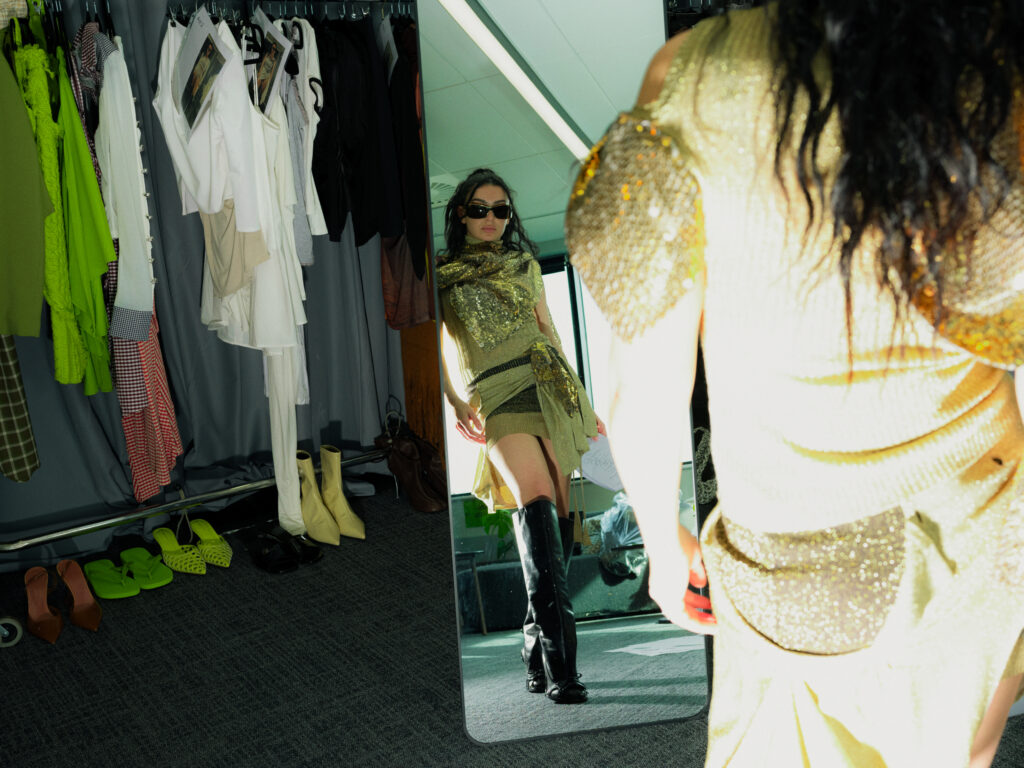
The queer angle is threaded through the film with a sharper, more confrontational edge. The Moment acknowledges how young LGBTQ+ people are so often pandered to by systems eager to borrow their language, aesthetics, and defiance while offering little in return. Brat culture, once a refuge and a rallying cry, becomes commodified into “brat bank cards”—symbols of inclusion that ultimately crash the very bank issuing them. The film exposes how queerness is leveraged as cultural capital, used to prop up a system that was never built to sustain it. In that collapse, The Moment finds its most pointed truth: when authenticity is mined for profit, it doesn’t just exploit queer audiences—it destabilizes the entire structure pretending to support them.
In the end, The Moment isn’t about rejecting success or mainstream attention outright. It’s about staying conscious inside of it. About laughing at the performance even as you’re still onstage. Funny, sharp, and quietly incisive, the film proves that Charli xcx isn’t just chronicling a cultural moment—she’s actively shaping it. And by turning the camera back on the spectacle itself, she reminds us that being brat was never about selling rebellion. It was about questioning who gets to define it in the first place.